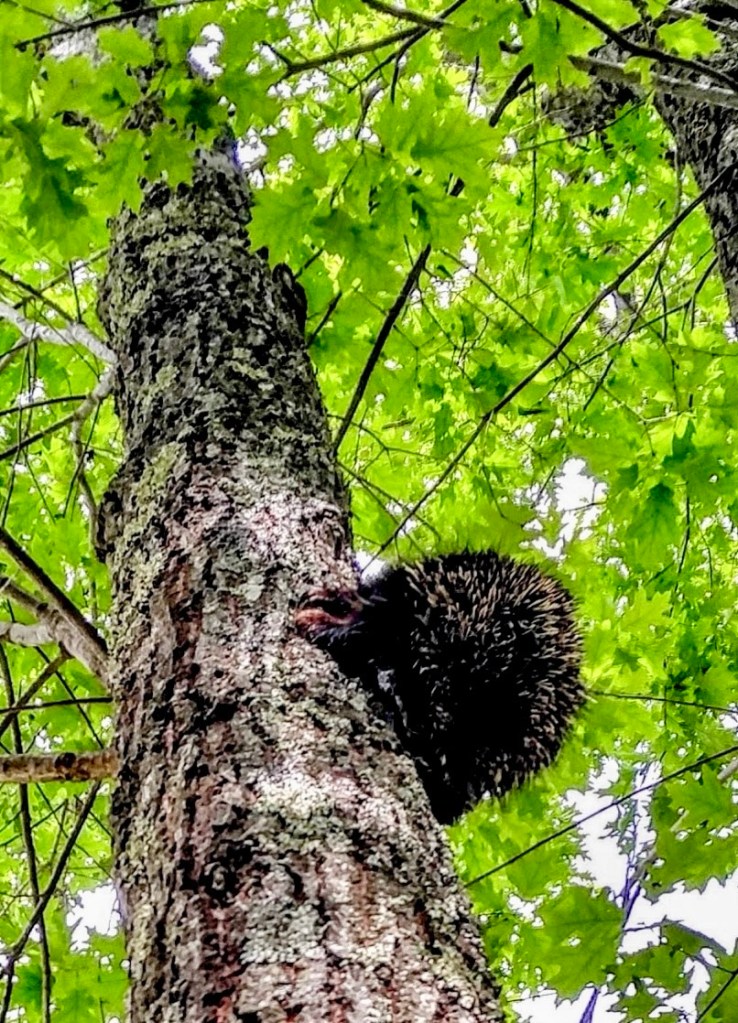
Thanks to bike journeys, I experienced my only porcupine encounter. The Big and I were in New England, and until that moment, I didn’t know porcupines climbed trees. Or maybe she’s the only one? She didn’t climb squirrel fast, but she was darned quick for someone hauling so many quills. Not so quick that I didn’t manage a photo, though.
I’ve also seen a number of sleek little creatures I assumed were mink, and they were squirrel fast. Slinky blurs, mink.
I saw a mountain lion from a distance in Nevada. She saw me, too. No, I’m not sure, but she seemed at peace, so yeah, although I don’t mean to traffic in gender cliches, she was probably she.
There were also lots of wild burrows in the Nevada desert. Good company, burrows. Curious. Gentle. Polite.
I’ve had one too-close encounter with a black bear, which is to say, she was close enough to acknowledge my presence. Again, not to assume anything that isn’t in evidence, but she had the physical attributes of a female black bear, so until she tells me otherwise, I’ll use she.
Oh, and despite having seen a number of bears in the wild, I can’t confirm or deny what popular wisdom says they do when in woods. But I can confirm that pedaling astronomers do. You know, when there are no more civilized options.
There was a lone wolf lounging in an open field as the Big and I rolled by, but lone wolf is another cliche, so guy. Stereotype or no, he wasn’t hungry enough to stalk even this slow-pedaling cyclist.
Packs of domesticated dogs are a regular nuisance. When alone, they run along beside the Big, celebrating the chase, but packs, like human mobs, get carried away.
I met a cyclist in southern Illinois who was injured in an encounter with a dog. No, the dog didn’t bite him. Instead, the dog got tangled with his bike’s front wheel, and the cyclist did an unplanned summersault over the handle bars, breaking his back upon contact with the ground. But that had been years earlier, and he was back in riding form — the cyclist, not the dog — when he accompanied me into Missouri. The dog was not injured.
Squirrels and raccoons are often opportunistic. Squirrels shredded a perfectly good tent, but that was my fault for snacking on sunflower seeds while lounging. Unlike raccoons, squirrels have the decency to look nervous about their aggression, but raccoons will straight up stare you down as they challenge you over a near-empty can of cold beans.
I’ve learned to leave a small stash of sunflower kernels away from my tent for squirrels and raccoons, but one evening, a gray fox helped herself. Are there more graceful beings than foxes? I wouldn’t have guessed foxes ate seeds.
By the way, sunflower kernels are inexpensive but nutritious fuel for pedalers too.
A squirrel ran into the spokes of the front wheel of the bike ridden by another cyclist I met. Bizarre, that. Gory, too. The cyclist suffered no physical injury, but I suspect he’ll never fully recover from witnessing that squirrel’s fate. It’s the only animal-bicycle encounter I know of that caused grievous injury to the animal.
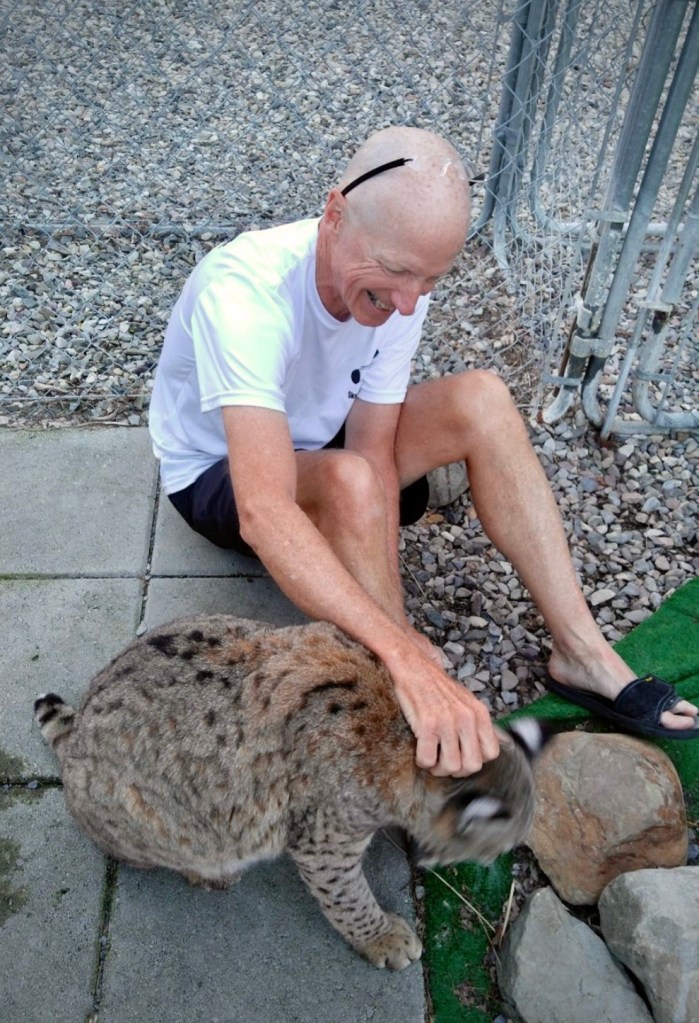
I met two bobcats at a New Jersey astronomical observatory while pedaling through that state. They’d lost their mother as infants, so were raised in captivity, and the state forbid their astronomer-rescuer from releasing them into the wild. Both were gentle and playful for such large cats, although one was a bit too intrigued by the scent of my feet. Ever had a bobcat’s whiskers tickle your toes?
I was awaiting sunset while wild camping, when a rabbit hot footed within six feet of me, followed closely by a coyote. Each was so focused on her or his respective goal, neither acknowledged my presence.
As I rested from a swim in a New England lake — seated on a boulder, feet dangling in cool, clear water — I noticed a semicircle of bream fascinated by my toes. They took turns darting in to nip, then rejoined their formation, and I thought, “No more fish and chips for me.” Nor flesh of any other creature. They were that cute, those little bream.
There have been lots of mountain goats, antelope, deer, and elk, plus badgers, ground hogs, chipmunks, and such. Even some bison. All ignored me but the chipmunks. Inquisitive little guys, those. Or maybe I just smelled of sunflower kernels.
My greatest nemeses, by far, are ants, especially in fire-ant territory. Which seems to be expanding. Ever dressed after a shower, and your underwear were covered in fire ants? Maybe I should revert to white briefs. Anyway, I’ve never danced with more enthusiasm.
I can keep bears from a bag of food by hanging it beyond their reach in a tree a few hundred yards away from my tent, but ants will find their way in, if the bag is not perfectly sealed. And clear nights when its rainfly is not needed, I still have to sleep inside a mesh inner tent, or ants will find me, too.
I was ambushed by how quickly moose can navigate thick forests despite their wide racks. They’re also more territorial than I expected. I’ll be more vigilant in moose country in the future.
I was pedaling a rural road in western Kansas shortly after dawn, when I happened upon what I estimate were two dozen vultures perched on fence posts, long wings fully extended to soak up warmth from the rising Sun. They stared at me in unison, shades of Poe, so I quickened my cadence.
Speaking of carrion eaters, most of the wildlife I see are no longer alive, this vast nation’s roadways being literal meat grinders.
In the central plains of this country, where corn is subsidized for the sake of caucus votes, the roadsides were especially gory. The kernels are allowed to dry on the stalks, then harvested by mammoth combines that separate them from the cobs and chaff. The kernels are transferred to large tractor-trailer rigs for transport to storage facilities, but some of the yield is spilled onto the roads along the way.
Small rodents and birds are squashed as they feast, while large birds of prey attracted to the scurrying rodents are killed, too. Plus, coyotes and foxes, and yes, vultures. I don’t know how to explain the millions of desiccated salamanders and frogs I’ve seen on roads, but they were right there among the other mangled masses.
Along with mutilated deer and bunnies, plus the occasional skunk. Domesticated cats and dogs, too.
Oh, and turtles. Not many snakes, but hords of flattened turtles.
So many scenes I now cannot unsee.
I don’t see as many live birds as I hoped — certainly not as many flocks as I did in my youth. Nor bats. I guess wind turbines account for some of those who are missing. We could design even more efficient machines for exterminating flying creatures, but the towering turbines do it well enough. I’ve read that the critters’ brains hemorrhage as they transition too quickly between the low- and high-pressure zones in the wakes of the spinning airfoils. I assume the birds and bats just kind of blink out, so I guess it’s a humane method, if your goal is extinction of flying beings.
One of the many benefits of bicycle travel is that the Big and I are of little threat to wildlife. We inconvenience flying insects at 10-15 miles per hour, but they bounce off of us rather than splatter, and despite my poor vision, I still see well enough to avoid most creatures who crawl about on road surfaces.
Well, there might be occasional ants I fail to detect. Sorry, ants. If it’s any consolation, I’d likely flatten even more of you if I walked. I suppose I could walk on stilts for the sake of ants and other tiny beings. That would minimize my literal footprints, assuming the stilt ends had less surface area than the soles of my feet. That would be almost as much fun as pedaling, too. But the Stilted Astronomer?
A lot of wildlife allow me to get surprisingly close when on the Big. I guess she and I are not as threatening when combined? Horses seem to hate us though. Well, one particular horse and rider on a public road through an equestrian village in Georgia. Shrill, that one. I imagined her name was Karen. The rider, not the horse.
Our automobiles, much like our houses, isolate us from the larger, more immersive environment. Bicycles reconnect travelers to the outside world, but at the cost of confrontation by the unfiltered devastation our automobiles leave behind.
There was one day when the roadkill I encountered were so numerous, I started photographing them. Lest I forget. No, I won’t subject you or anyone else to those images. Just know, it was in that moment when I felt well and truly ashamed I’d ever driven an automobile. The horrors we so casually inflict on this world’s other creatures are of incomprehensible scale.
Before vision loss ended my driving career, I’d piloted a series of automobiles about 1.5 million miles, oblivious to the carnage caused by my actions. Now that I no longer drive, I’m fond of claiming there is something more human about the pace of a bicycle.
But it’s also more humane.